
Rules contents
Learn to Play
The Rules
Reference
The Rules
Units
Every regiment, monster and hero is a unit. A unit's stat line, its type and its properties tell you how it moves, how it fights and how long it holds.
A unit is a block of models that moves and fights as one: twenty Dwarf Warriors in four ranks of five, a squadron of five knights, or a single dragon. Units are always activated, moved and attacked as a whole.
The stat line
Every unit has six stats. You’ll find them on the unit card in the game, and on every unit in the army lists.
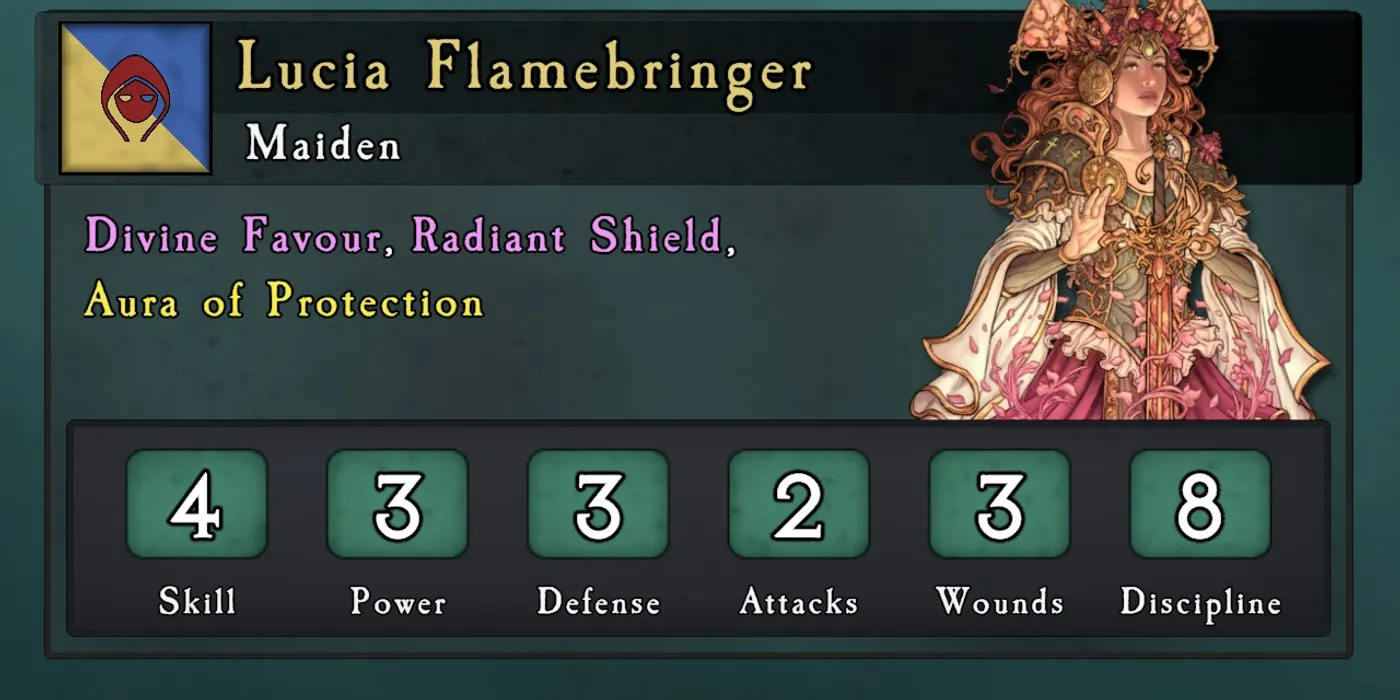
- Skill
- Training and fighting ability. Compared with the enemy’s Skill to decide your chance to hit in melee, and sets your chance to hit with ranged attacks.
- Power
- Strength and striking force. Compared with the target’s Defense to decide how hard your hits are to save.
- Defense
- Toughness and armour. Sets the damage save the unit makes against incoming hits.
- Attacks
- How many attack dice each model rolls in melee.
- Wounds
- How much damage each model takes before it is removed.
- Discipline
- Courage and nerve. The target for Discipline tests: roll it or under on two dice to hold firm.
Stats can be changed by weapons, armour, spells and abilities. The game always shows the current value, with any modifiers already applied.
Unit types
A unit’s type sets its base size, how far it moves, and how wide its ranks can be. Most units can change their stats with equipment, but their type never changes.
| Unit type | Move | Turn 90° | Rank width | Base (mm) |
|---|---|---|---|---|
| Infantry | 8" | 2" | 5–7 | 20×20 |
| Large Infantry | 8" | 2" | 4–6 | 25×25 |
| Swarm | 8" | 2" | 3–4 | 40×40 |
| Weapon Team | 8" | 2" | 4–6 | 25×50 |
| Beasts | 12" | 3" | 4–6 | 20×40 |
| Cavalry | 16" | 4" | 4–6 | 25×50 |
| Lance Cavalry | 16" | 4" | 3–6 | 25×50 |
| Monstrous Infantry | 12" | 3" | 3–4 | 40×40 |
| Light Chariot | 16" | 4" | 2–3 | 50×100 |
| Chariot | 16" | 4" | — | 50×100 |
| War Wagon | 12" | 3" | — | 50×100 |
| Large Monster | 12" | 3" | — | 50×50 |
| Large Monster (long base) | 12" | 3" | — | 50×100 |
| Gargantuan | 12" | 3" | — | 100×150 |
| War Machine | 0" | free | — | 50×50 |
- Move is the distance the unit can move in one activation, and also its charge reach. Some properties change it. For example, Heavy Armor costs 1”, Swift adds 1”, and Flying sets it to 20”.
- Turn 90° is what it costs to pivot a quarter turn. Pivots cost a quarter of the unit’s Move per 90°, so a half turn costs half its Move. War Machines pivot for free.
- Rank width is how many models a unit can have in its front rank. You choose the width in the Army Builder. A dash means the unit is a single model, or fights as one.
Ranks and rank bonus
Models in a unit stand in ranks, filling the front rank first. A unit’s ranks are its full ranks, plus a partial rear rank if it has at least three models. A unit with fewer than three models has no ranks.
Ranks give a unit staying power:
- Discipline tests add the unit’s full rank count to its Discipline. Twenty Dwarf Warriors, five wide, have four ranks and test on Discipline +4.
- Combat score: a unit in melee adds +1 for its second rank and +1 more for a third, up to +2, as long as it isn’t disrupted. See Combat score.
- Supporting attacks: models in the second rank add attacks to the front. See Who attacks.
Wide units hit harder and are harder to flank. Deep units hold their nerve. Choosing the width is one of the first decisions you make with every unit.
Wounds and casualties
Damage on a unit is pooled. Each wound the unit suffers goes onto the pool, and every time the pool reaches the unit’s Wounds stat, one model is removed and the pool empties. Extra wounds carry over to the next model. A wounded model’s damage stays from one turn to the next, so a half-dead Troll is still half dead next turn.
A unit is destroyed when its last model is removed.
Commanders
Every army is led by Commanders. In the Army Builder each commander is attached to a unit, its retinue, and fights at the head of it for the whole battle.
- A commander has its own stat line and fights in melee with its own Skill, Power and Attacks. See Commanders in combat.
- While the commander lives, the unit uses the commander’s Discipline for all its Discipline tests.
- The commander gets its own ability each activation, as well as the unit’s. See Abilities and spells.
- Enemy rank-and-file can’t single out a commander in a unit. Shooting always hits the retinue. Only an enemy commander can attack a commander directly, until the retinue is gone.
If the whole retinue is destroyed, the commander fights on alone as a solo commander, with its own stats and no ranks. Some commanders ride a monster or a chariot instead. If that mount is slain, the rider falls with it. A few commanders are monsters themselves and never have a retinue.
Discipline tests
Some moments test a unit’s nerve. Roll two dice and add them together. The unit passes if the total is equal to or less than its target:
Target = Discipline + ranks − penalty
The game makes a Discipline test in two situations:
- Break tests, after losing a melee. The penalty is how much the combat was lost by. See Break tests.
- Rally tests, when a fleeing unit tries to recover. There is no penalty. See Rallying.
Nothing else makes a unit test. Heavy shooting, a nearby unit fleeing, or a commander’s death never forces a Discipline test on its own.
Some properties change Discipline tests:
- Fearless units ignore the penalty for losing a combat. Their ranks still count.
- Reanimated, Demonic and Construct units never flee. Instead they crumble: when they lose a combat they don’t roll, and lose D3 wounds instead.
- Bodyguard units re-roll a failed test when a commander is with them.
Properties
Everything else a unit can do comes from its properties:
- weapon sets, such as Hand Weapon and Shield, Spear and Shield, and Greatweapon;
- ranged weapons;
- armour;
- special rules, such as Fearless, Frenzy, Scout and Flying;
- commanders’ abilities and spells.
Each property is listed on the unit in the army lists and explained in the Glossary. The most common ones are below.
Weapon sets
| Weapon set | Effect |
|---|---|
| Hand Weapon | Charge bonus: +1 Power. |
| Hand Weapon and Shield | +1 Defense. Charge bonus: +1 Power. |
| Spear and Shield | +1 Defense. When the unit has no charge bonus, its third rank also makes supporting attacks. |
| Greatweapon | +1 Power. Charge bonus: +1 Power. |
| Halberd | Charge bonus: +1 Power. Enemy damage saves against it in melee are never better than 4+. |
| Two Hand Weapons | +1 Attacks. |
| Lance and Shield | +1 Defense. Charge bonus: +2 Power. |
A charge bonus applies only in the first round of combat after the unit charges or counter-charges. Monsters and beasts fight with claws, fangs, horns or tusks, which give charge bonuses of their own.
Common properties
- Heavy Armor
- +1 Defense, −1” Move.
- Sturdy
- −1” Move, but ignores the Move penalty from Heavy Armor.
- Swift
- +1” Move.
- Scout
- Ignores difficult terrain.
- Flying
- Move becomes 20”. Flies over all terrain and units, but can’t end a move on them. Never in cover, and can’t capture objectives.
- Ambusher
- Deploys in the ambush zone, much further forward than your normal deployment zone.
- Fearless
- Ignores the penalty for losing a combat on Discipline tests.
- Frenzy
- Re-rolls missed attack rolls in the first round of combat. Can’t flee from a charge.
- Regeneration
- Heals all missing wounds at the end of the turn.
- Poisoned Attacks
- Enemies re-roll damage saves of 6.